claude monet
Biography
Birth and childhood of claude monet
Claude Monet also known as Oscar-Claude Monet or Claude Oscar Monet (November 14, 1840 – December 5, 1926) was a founder of French impressionist painting, and the most consistent and prolific practitioner of the movement’s philosophy of expressing one’s perceptions before nature, especially as applied to plein-air landscape painting. The term Impressionism is derived from the title of his painting Impression, Sunrise.
Claude Monet was born on November 14, 1840 on the fifth floor of 45 rue Laffitte, in the ninth arrondissement of Paris. He was the second son of Claude-Adolphe and Louise-Justine Aubrée Monet, both of them second-generation Parisians. On May 20, 1841, he was baptized into the local church parish, Notre-Dame-de-Lorette as Oscar-Claude. In 1845, his family moved to Le Havre in Normandy. His father wanted him to go into the family grocery store business, but Claude Monet wanted to become an artist.
1861
First Regiment of African Light Cavalry
Monet joined the First Regiment of African Light Cavalry in Algeria for two years of a seven-year commitment, but upon his contracting typhoid his aunt Marie-Jeanne Lecadre intervened to get him out of the army if he agreed to complete an art course at a university.
1862
Charles Gleyre
Monet became a student of Charles Gleyre in Paris, where he met Pierre-Auguste Renoir, Frédéric Bazille, and Alfred Sisley. Together they shared new approaches to art, painting the effects of light en plein air with broken color and rapid brushstrokes, in what later came to be known as Impressionism.
1870
Franco-Prussian War
Monet took refuge in England in September 1870. While there, he studied the works of John Constable and Joseph Mallord William Turner, both of whose landscapes would serve to inspire Monet’s innovations in the study of color. In the Spring of 1871, Monet’s works were refused authorisation to be included in the Royal Academy exhibition.
1871
Zaandam
In May 1871 he left London to live in Zaandam, where he made 25 paintings (and the police suspected him of revolutionary activities). He also paid a first visit to nearby Amsterdam. In October or November 1871 he returned to France.
1879
Camille Doncieux
Monet and Camille Doncieux had married just before the war (June 28, 1870). She became ill in 1876. They had a second son, Michel, on March 17, 1878, (Jean was born in 1867). This second child weakened her already fading health. At the age of thirty-two, Madame Monet died on 5 September 1879 of tuberculosis; Monet painted her on her death bed.
1926
French Academy of Fine Arts
Monet died of lung cancer on December 5, 1926 at the age of 86 and is buried in the Giverny church cemetery..His famous home and garden with its waterlily pond were bequeathed by his heirs to the French Academy of Fine Arts (part of the Institut de France) in 1966. Through the Fondation Claude Monet, the home and gardens were opened for visit in 1980, following refurbishment.
works
MOST FAMOUS CLAUDE MONET'S ARTWORKS
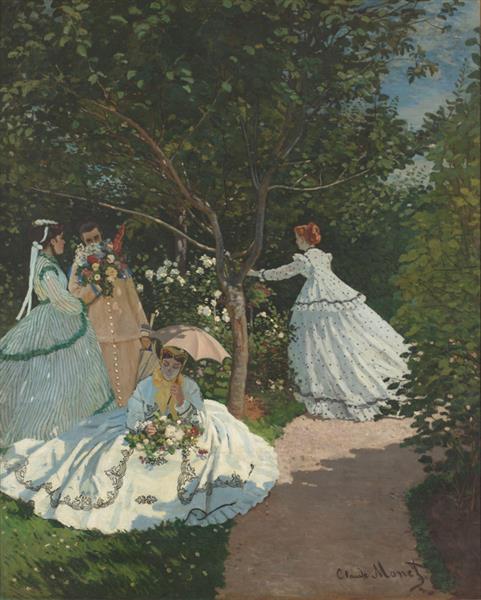
Women in the garden
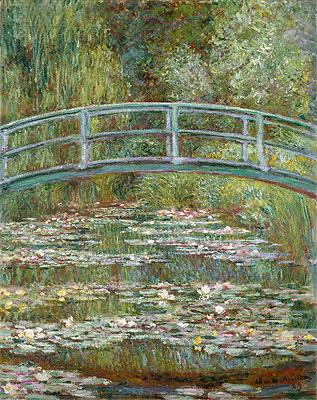
Bridge over a Pond of Water Lilies
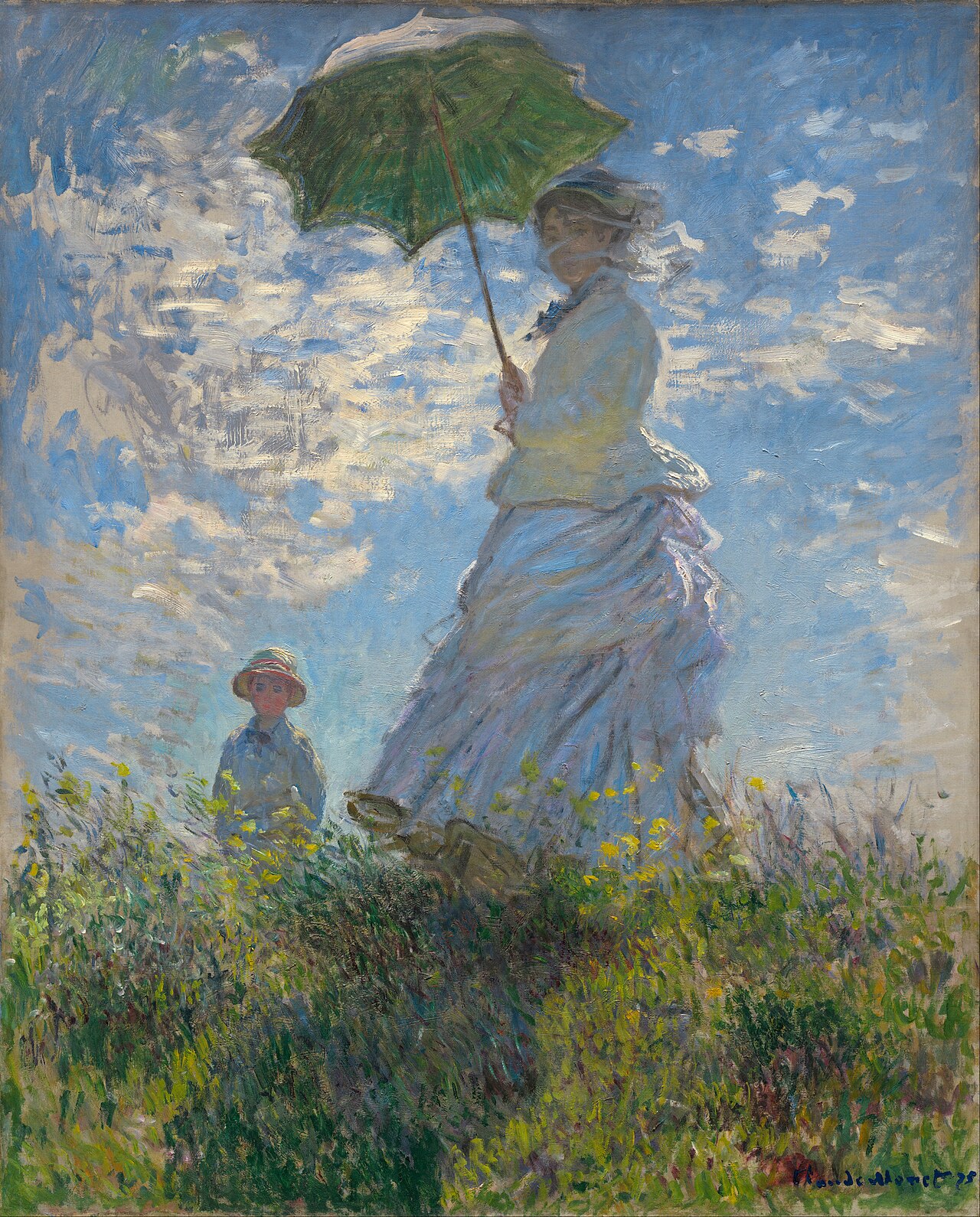
Woman with a Parasol
ARTWORKS
throughout monet's life he painted many famous artworks
1872
Impression, Sunrise
It hung in the first Impressionist exhibition in 1874 and is now displayed in the Musée Marmottan-Monet, Paris. From the painting’s title, art critic Louis Leroy coined the term “Impressionism”, which he intended as disparagement but which the Impressionists appropriated for themselves.
1875
Camille Monet and a Child in the Artist’s Garden in Argenteuil
Camille, Monet’s first wife, is shown with a child in the garden of their house in Argenteuil, near Paris, where they lived between 1872 and 1877. Today, Claude Monet is primarily known as a landscape painter, but in the beginning of his artistic career, he used to concentrate on portraits. No one else appeares in Monet’s paintings as often as Camille.
1886
Haystack at Giverny
The scenery of Giverny was to provide him with the perfect quality of light and the topographical framework to evolve his continuing treatment of light and atmosphere. Perhaps the choice of Haystacks as an object for this sort of experimentation was done because Claude required something that was relatively three-dimensional and did not have too much external detail that might complicate the findings of his studies of light and season.
1891
Three Trees in Grey Weather
Monet’s use of broken brushstrokes challenges traditional representation. The structural integrity of the scene relies not on precise outlines but on the interplay of light and color. This technique aligns with the broader Impressionist movement, which sought to capture the fleeting essence of a scene rather than its solid form. Here, color and light are not secondary; they define the subject itself.
1917 - 1919
Water Lilies
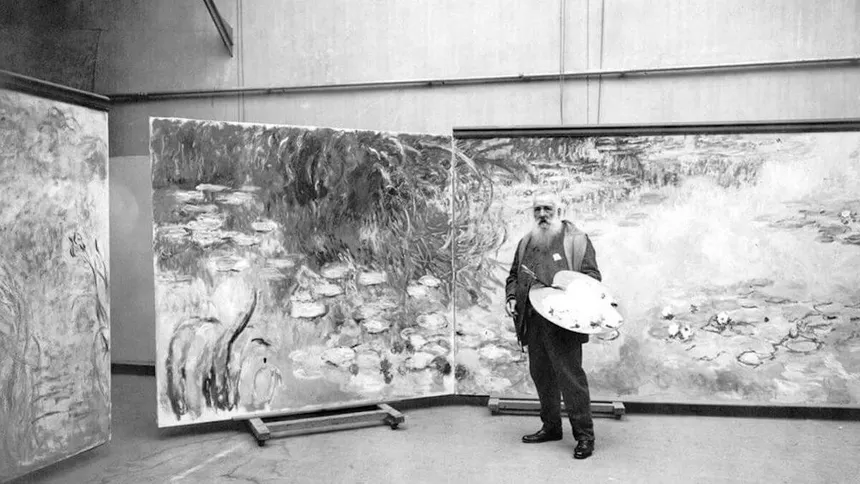
Monet’s Water Lilies series contained around 250 paintings, which he painted during the last thirty years of his life at his house in Giverny, France. Many of the paintings were completed while Monet was suffering from cataracts, which gave him a redder tone to his vision, which is represented in some of his paintings. He went through two surgeries in 1923 to remove his cataracts, which many have left his eyes more sensitive to ultraviolet wavelengths, as he went back and repainted some of his water lilies with a bluer tone. Works from Monet’s Water Lilies series are now housed all over the world, and have sold at auction for almost $41 million.
funeral
Claude monet's
last days
Monet died of lung cancer on 5 December 1926 at the age of 86 and is buried in the Giverny church cemetery. Monet had insisted that the occasion be simple; thus, only about fifty people attended the ceremony. At his funeral, Clemenceau removed the black cloth draped over the coffin, stating: “No black for Monet!” and replaced it with a flower-patterned cloth. At the time of his death, Waterlilies was “technically unfinished”.